Detailed Explanation of Lids for Aluminum Foil Containers (Heat-Seal Aluminum Foil Lids, PP Lids, PET Lids, Paper-Foil Lids)
Aluminum foil containers are widely used in food packaging, medical consumables, food delivery, and other fields due to their lightweight nature, environmental friendliness, and excellent thermal conductivity. As a core component of these containers, the accompanying lid directly affects the product’s seal integrity, freshness, safety, and user experience.
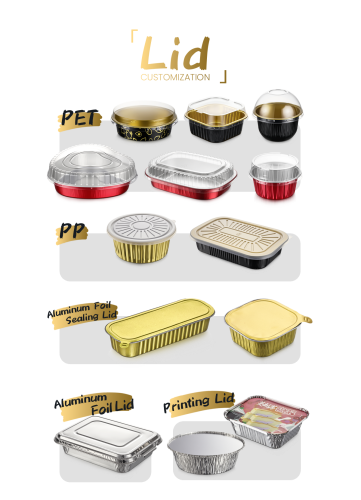
Currently, the mainstream lids for aluminum foil containers on the market fall into four main categories: heat-seal aluminum foil lids, polypropylene (PP) lids, polyethylene terephthalate (PET) lids, and paper-foil composite lids. This article provides a comprehensive and detailed analysis of these lid types from perspectives including material composition, manufacturing processes, applications, usage precautions, and advantages/disadvantages. Additionally, we introduce our customization services to meet diverse client-specific requirements.
1. Material Overview of Each Lid Type
The lid material directly determines its core performance characteristics. The four lid types differ significantly in material properties, making them suitable for distinct application scenarios and needs:
1.1 Heat-Seal Aluminum Foil Lid
Core Material: Food-grade aluminum foil (typically 0.012–0.020 mm thick), coated with a specialized heat-seal adhesive layer (e.g., PE or EVA-based sealant).
Premium variants may include an additional protective film to enhance heat-seal stability and corrosion resistance.
The aluminum foil used is ≥99.7% pure, food-grade primary aluminum—free of impurities and odors—and complies with national safety standards for food-contact materials, allowing direct contact with food or medical products.
Heat sealed aluminum foil cover
1.2 PP Lid
Material: Food-grade polypropylene (PP), available as homopolymer or copolymer PP.
Copolymer PP is preferred for container lids due to its superior toughness and temperature resistance.
PP is non-toxic, odorless, chemically stable, and free of harmful substances. It offers good impact resistance and processability. Colorants can be added to produce various colors, and antimicrobial agents can be incorporated to enhance hygiene performance.
PP lid
1.3 PET Lid
Material: Food-grade polyethylene terephthalate (PET)—an eco-friendly polymer known for high transparency, excellent mechanical strength, and smooth surface ideal for printing.
PET is non-toxic, heat-resistant (can withstand short-term exposure above 60°C), chemically resistant, and fully recyclable—aligning with current green packaging trends.
Some products undergo lamination to improve sealing performance and abrasion resistance.
PET lid
1.4 Paper-Foil Lid
Composite Structure: Typically consists of food-grade kraft paper or white cardboard laminated with a thin aluminum foil layer.
Optional treatments include water-resistant coating on the paper side and heat-seal adhesive on the foil side.
The paper component is biodegradable and eco-friendly; the aluminum foil provides barrier and freshness-preserving properties—combining the sustainability of paper with the functional barrier of foil.
Paper foil lid
2. Manufacturing Processes
Manufacturing methods vary significantly by material, focusing on precision forming, sealing performance, and safety:
Key Considerations: Uniform adhesive coating is critical for reliable heat sealing; die-cut dimensions must precisely match the container rim to prevent leaks.
2.2 PP Lid
Process: PP raw material procurement → Blending (with colorants/antimicrobials if needed) → Melt extrusion (180–220°C) → Injection molding → Deburring → Quality inspection → Packaging.
Key Considerations: Precise control of injection temperature and cooling rate prevents shrinkage or deformation; deburring ensures smooth edges to avoid injury or sealing issues.
2.3 PET Lid
Process: PET raw material procurement → Drying (moisture <0.02%) → Melt extrusion (260–280°C) → Injection or thermoforming (injection for small lids, thermoforming for larger ones) → Optional surface treatment (printing/lamination) → Trimming & inspection → Packaging.
Key Considerations: Thorough drying is essential to avoid bubbles; stable temperature and pressure during forming prevent warping or breakage.
2.4 Paper-Foil Lid
Process: Paper and foil procurement → Dry lamination (60–80°C) → Optional surface treatments (waterproofing on paper, heat-seal coating on foil) → Die-cutting → Optional creasing (for easy opening/folding) → Quality inspection → Packaging.
Key Considerations: Lamination must be bubble-free and delamination-resistant; coatings must be evenly applied to ensure functionality.
3. Application Scenarios
Each lid type excels in specific use cases based on its material and processing characteristics:
3.1 Heat-Seal Aluminum Foil Lid
Ideal for: Food and medical packaging requiring hermetic sealing, freshness retention, leak prevention, and high-temperature sterilization.
• Inferior sealing vs. foil • Poor water resistance (uncoated) • Not heat/microwave-safe • Risk of delamination • Soft—deforms under stacking
6. Customization Services
We specialize in the R&D, production, and customization of aluminum foil containers and their lids. We offer full-specification customization to precisely match your container dimensions, application scenarios, and brand identity.
Customization Options Include:
Container Shapes: Round, square, irregular—tailored to your product size.
Material Specifications: Foil thickness, lid material selection.
Aesthetic Design: Colors, logo printing, patterns, easy-tear features, crease lines.
With a minimum order quantity of just 100 cartons, our services are accessible to small restaurants, startup food brands, large food processors, and medical supply companies alike.
Our professional R&D team, precision equipment, and rigorous quality control ensure every custom batch meets national safety standards, delivers consistent quality, and ships on time. We provide dedicated one-on-one support throughout the process to address all your customization concerns.
In Summary:
Choose heat-seal aluminum foil lids for maximum sealing and high-temperature applications.
Opt for PP lids for cost-effective, durable solutions in ambient conditions.
Select PET lids when transparency and sustainability are priorities.
Go with paper-foil lids for eco-friendly, biodegradable packaging with basic barrier needs.
Contact us to discuss your specific needs - we will help you choose or customize the perfect aluminum foil container to enhance the competitiveness of your product.



 Blog Aluminum foil containers lid