Abstract: As a key player in modern packaging, aluminum foil containers, with their unique material properties and versatility, have deeply penetrated core sectors such as food packaging, pharmaceuticals, airline catering, and prepared meals. This article systematically analyzes the material characteristics, forming processes, and applications of aluminum foil, focusing on technological innovations and recycling challenges within the context of sustainable development. It aims to comprehensively present the technical essence and future trends of this lightweight packaging solution.
1. Material Essence: The Micro-Properties of Aluminum Foil
The base material for aluminum foil containers is industrial pure aluminum (typically grades like AA8011, AA1235), cold-rolled to an extremely thin gauge (commonly 0.06mm-0.2mm) through multiple passes. Its core properties stem from the metallic nature of aluminum and the rolling process:
let's know more about aluminum foil containers
Exceptional Barrier Properties: The dense crystalline structure of aluminum foil provides a complete barrier against light, oxygen, water vapor, and microorganisms. This offers near-perfect protection for contents, significantly extending shelf life and making it ideal for sensitive foods like pastries, cooked meals, and dairy products.
let's know more about aluminum foil containers
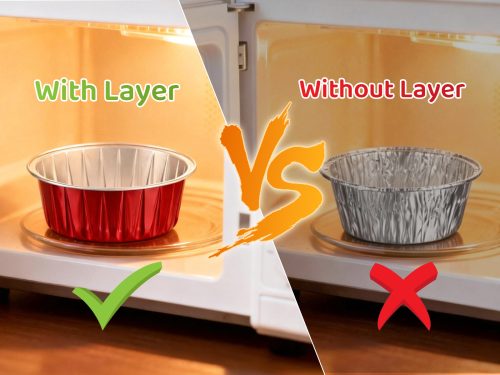
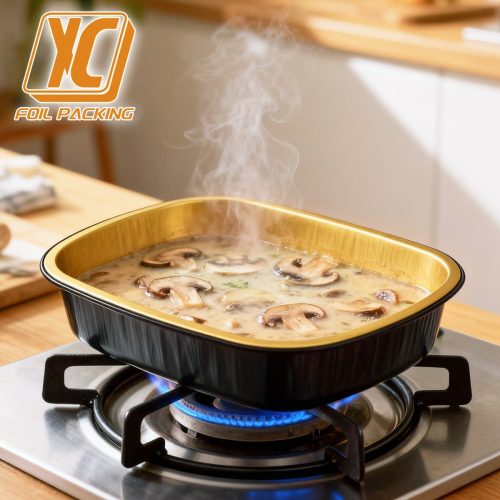
Excellent Thermal Conductivity and Temperature Resistance: Aluminum foil containers can be used directly for oven baking, steam heating, or frozen storage (stable within a range of -40°C to 250°C), enabling seamless transition from cold chain to hot chain. This perfectly suits the "heat-and-eat" demands of the prepared meal and food delivery markets.
High Strength and Formability: Despite being thin, work hardening from rolling imparts sufficient mechanical strength. Through processes like stamping, folding, and spinning, containers of various complex shapes can be formed. Edges can be precisely curled and sealed to ensure hermeticity.
Lightweight and Space Efficiency: The low density of aluminum results in lightweight finished containers, helping to reduce logistics costs. Their stackable design also saves storage and transportation space.
2.Structural Evolution: Engineered Design from Single Layer to
1. Composites:Pure aluminum foil is prone to wrinkling and cannot be heat-sealed directly. In practical applications, composite material technology is often employed to optimize performance:
Classic Structure: Aluminum foil/PE (Polyethylene) or PET/Aluminum foil/CPP (Cast Polypropylene). The outer PET layer provides a printable surface and mechanical protection, the aluminum foil core layer provides the barrier, and the inner heat-seal layer (PE/CPP) ensures a safe seal and prevents direct contact between the aluminum and food, avoiding electrochemical reactions.
Functional Innovations:
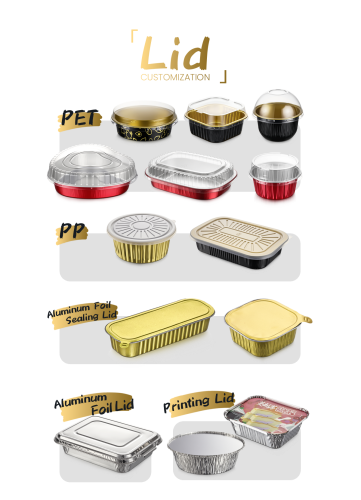
Easy-Peel Lids: Utilize composites of aluminum foil and easy-peel materials for a consumer-friendly opening experience.
Antimicrobial Coating: Application of coatings containing agents like silver ions on the inner surface to further enhance food safety.
Stamping/Deep Drawing: The mainstream process. Uses precision dies on high-speed presses for single-step forming. It offers high efficiency and dimensional accuracy, suitable for high-volume production of standard shapes (e.g., round, rectangular meal boxes).
Beading and Seaming: After forming, edges are processed by automatic beading machines, followed by heat-seaming with lid stock to create an airtight or liquid-tight seal.
Surface Treatment: Aluminum foil surfaces can undergo anodizing, painting, or lamination. This not only enhances corrosion resistance but also provides high-quality color printing and graphic display space for branding.
Pharmaceuticals: Blister packaging (PTP) for tablets and capsules, ensuring moisture and light protection.
Specialized Uses: Packaging for high-temperature sterilized medical devices, moisture-proof packaging for industrial parts.
5. Sustainability: Challenges and Cutting-Edge Breakthroughs
The environmental profile of aluminum foil containers presents a "dual-sided" picture, making their green evolution a key industry focus.
Challenges:
Energy-Intensive Primary Production: Primary aluminum electrolysis is extremely energy-intensive, resulting in a significant carbon footprint.
Recycling Challenges of Composite Structures: The complex technology required to separate aluminum-plastic composites makes them difficult to process in traditional recycling streams, often leading to downcycling or entry into the waste stream.
Innovative Solutions:
Closed-Loop Recycling Advantage: Aluminum's infinite recyclability is key. Producing recycled aluminum requires only about 5% of the energy needed for primary aluminum. Dramatically increasing recycling rates is fundamental to reducing environmental impact.
Down-Gauging and Lightweighting: Continuous reduction of aluminum foil usage per unit through alloy optimization and improved processing, while maintaining performance.
Monomaterial Design: Developing all-aluminum monolithic structures that reduce or eliminate plastic composite layers, or using separable eco-friendly coatings to improve recycling compatibility.
Advanced Recycling Technologies: Developing technologies like pyrolysis and solvent-based processes to efficiently recover both the aluminum and high-value plastics from composite materials.
Life Cycle Assessment (LCA) Driven: Comprehensive evaluation of the full life cycle impact from production to end-of-life. LCAs can demonstrate that the overall environmental benefits, achieved through exceptional protection that reduces food waste, may offset a portion of the production emissions.
6.Future Outlook
The future of aluminum foil containers will evolve along dual tracks of "high performance" and "ecologization":
Smart Integration: Exploring integration with functional materials like RFID tags and time-temperature indicators.
Design Empowerment: Enhancing consumer experience through more elegant structural and graphic design, evolving from mere packaging to a brand medium.
Circular Economy Integration: Relying on policy drivers (like Extended Producer Responsibility) and consumer education to establish efficient collection and sorting systems, truly integrating them into the circular economy chain.
Conclusion: Aluminum foil containers are not simple vessels but the precise crystallization of material science, precision manufacturing, and user needs. Faced with the imperatives of the sustainability era, their future competitiveness depends not only on their inherent excellent performance but also on the industry's ability to successfully address environmental challenges through material innovation, process optimization, and recycling system reconstruction, thereby transitioning from a "convenience choice" to a "responsible choice." On the balance between performance and environmental responsibility, aluminum foil containers, through technological innovation, are seeking a more optimal equilibrium.



 Blog Aluminum foil containers lid
 Blog Aluminum foil containers